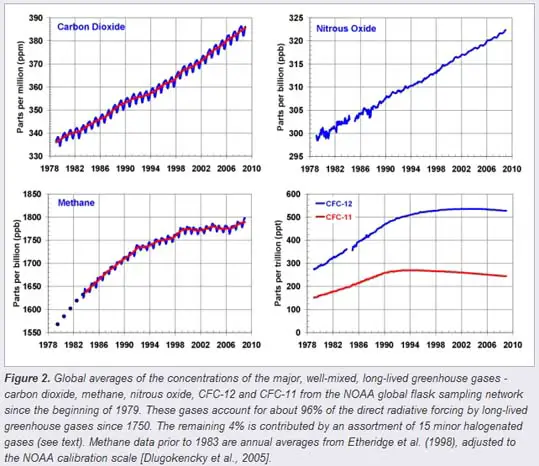
Growth in global greenhouse gas emissions in highest since In , the growth in total global greenhouse gas (GHG) emissions (excluding those from land-use change) resumed at a rate of %, reaching gigatonnes of CO 2 equivalent Mar 25, · Electricity and Heat Production (25% of global greenhouse gas emissions): The burning of coal, natural gas, and oil for electricity and heat is the largest single source of global greenhouse gas emissions.; Industry (21% of global greenhouse gas emissions): Greenhouse gas emissions from industry primarily involve fossil fuels burned on site at facilities for energy Apr 07, · Global warming causes, effects, extreme weather, facts, and relation to climate change. impacts—mean we must accelerate our efforts to reduce greenhouse gas emissions
Global Greenhouse Gas Emissions Data | US EPA
The post, in its current form, has since been edited to include updated content as of April 1st, This question is not as silly as it may seem. This blog post is consistently the most frequently visited page on our website.
It is a topic so fundamental to carbon management that many practitioners are probably afraid to seek clarification out of fear of looking uninformed. But first you should read my previous blog global warming and greenhouse gas emissions on greenhouse gaseswhich has also been updated.
If you want to dig into the science more, you can refer to the latest IPCC assessment report published in — see Chapter 8 of the Working Group I report. Global Warming Potentials GWPs are a quantified measure of the globally averaged relative radiative forcing impacts of a particular greenhouse gas. It is defined as the cumulative radiative forcing — both direct and indirect effects — integrated over a period of time from the emission of a unit mass of gas relative to some reference gas IPCC Carbon dioxide CO 2 was chosen by the IPCC as this reference gas and its GWP is set equal to one 1.
GWP values allow you to compare the impacts of emissions and reductions of different gases. So to be clear, GWP values are applied to units of mass e. not to units of volume e, global warming and greenhouse gas emissions. We typically only use GWP values for gases that have a long atmospheric lifetime i.
Because only these gases last long enough in the atmosphere to mix evenly and spread throughout the atmosphere to form a relatively uniform concentration. Specifically, the gases with relatively long atmospheric lifetimes that tend to be evenly distributed throughout the atmosphere, and therefore have global average concentrations, are CO 2CH 4N 2 O, HFCs, PFCs, SF 6 and NF 3.
There are numerous other more obscure chemicals you can investigate in the IPCC AR5 report chapter. The short-lived gases such as water vapor, carbon monoxide, tropospheric ozone, other ambient air pollutants e.
Some GWP values may account for indirect as well as direct effects. In sum, the higher the GWP value the more infrared radiation the gas will tend to absorb over its lifetime in the atmosphere, leading to more warming.
Now, there are three more complications to this story. The first is that gases will absorb certain wavelengths of radiation. The more that window is filled up, the less there is to absorb.
So, as concentrations of certain gases increase they can saturate that wavelength, leaving no more radiation for additional concentrations of gas in the atmosphere to absorb. The second complication is one that occasionally trips people up. Well, that means that we have to define a time period for the integration to occur. You have to know what the integration period is to make sure you are using the correct GWP, global warming and greenhouse gas emissions. The typical periods that the IPCC has published are 20,and years the latest report quit publishing values for years.
Now, to be clear, everyone pretty much universally uses year GWP values, so you often never see the time period even cited. It is just assumed you know it is years. But occasionally, someone will use something different, not realizing that they are breaking convention. It is also possible to compute an infinite time horizon GWP value, which would basically mean that accounted for every bit of radiative forcing of every molecule of gas as long as it existed in the atmosphere.
The last complication relates to the fact that the IPCC keeps updating its GWP values with each of its scientific assessment reports. It makes sense to update GWP values as our scientific understanding improves.
However, the problem is that people are using and making commitments based on GWP values while these revisions are taking place. Global warming and greenhouse gas emissions all of a sudden GWP values change and now they no longer make the goal using the new GWP values due to the mix of different GHGs they emit and reduce.
It would be like moving the net after global warming and greenhouse gas emissions already kicked the ball towards the goal. For this reason, the Kyoto Protocol fixed the use of GWP values published by the IPCC in in its Second Assessment Report. Since then the IPCC has updated its GWP values three times, in, and The result has been a proliferation of GWP values out there that leads to a lot of confusion.
When the radiative forcing of CO 2 is updated, then the GWPs of the other gases relative to CO 2 also change. The IPCC has also added numerous new, and rarely used, gases to its list of GWPs.
The result of the varying time periods and the regular updates by the IPCC is a complicated state of affairs. This table presents GWP values for the most common GHGs there are many more if we listed all the HFCs, PFCs, halogenated alcohols and ethers and other trace gases.
As you can see in this table, each gas has number of GWP values that you could choose. But the truth is, contrary to what a lay person might expect, we typically only use values over a year time period, even though some gases have lifetimes of thousands of years. Until recently, we also almost always used the values published by the IPCC because they were adopted by the UNFCCC and Kyoto Protocol.
However, now with the Kyoto Protocol effectively over, the UNFCCC has now adopted the IPCC AR4 values for international reporting.
Yet, we now have newer values from the IPCC AR5 report. So, after many years of stability based on the IPCC values, we have entered a period of confusion surrounding what vintage of GWP global warming and greenhouse gas emissions should be universally applied so all climate change programs and policies around the world are consistent in their emissions accounting. And highlighted in green are the most recent values from the IPCC AR5.
I wish I could tell you which one to use. As a default, I would recommend you use the red values to be consistent with the UNFCCC. But recognize that an agreement later this year in Paris could adopt the new AR5 values.
Row 1: IPCC AR5 See Chapter 8 of Working Group I report. Row 2: IPCC AR4 See Chapter 2 of Working Group I report. Row 4: IPCC TAR See Chapter 6 of Working Group I report. Row 4: IPCC SAR See Chapter 2 of the Working Group I report. To wrap things up for the sake of being thorough, the relationship between mass of a gas and mass of CO 2 Eq.
can be expressed as follows:. mass CO 2 Eq. So the calculation is easy. Just multiply the mass of your gas by its GWP value to get CO 2 equivalent emissions, global warming and greenhouse gas emissions. So, if you hear someone talking about carbon emissions make sure you have them clarify what they are actually talking about. And in case you were wondering, according to the IPCC, GWPs typically have an uncertainty of roughly ±35 percent, though some GWPs have larger uncertainty than others.
Lastly, there is one more confusing issue, which I will only touch on briefly. There are numerous gases like chlorofluorocarbons CFCshydrobromocarbons e. These gases are being phased out global warming and greenhouse gas emissions the Montreal Protocol and related international agreements.
They are also GHGs, although their impact on radiative forcing is even more complex because stratospheric ozone is also a GHG. So, ozone depleting substances ODSs have both positive and negative radiative forcing effects. We generally do not include them in GHG emission inventories because they are being phased out, although some carbon offset projects are crediting the destruction of ODSs. Read the previous post in this series. Learn More. Although built into the Kyoto Protocol, GWPs have serious flaws.
Users should be aware of these flaws. The three papers listed below are my own work, global warming and greenhouse gas emissions, but there are many other including more recent papers on the topic.
Wigley, T. Geophysical Research Letters 25, — Smith, S. and Wigley, T. Climatic implications of emissions reductions. Climatic Change 44, — Climatic Change 44, I was hoping that someone would open up the debate over whether GWPs, in their current form, are the best index to use for GHG emissions accounting.
Michael, global warming and greenhouse gas emissions, Excellent article as always. This is a fallacy. While one does buy a rapid reduction by reducing methane or black carbon emissions, this has little or no effect on the long term climate, which is essentially controlled by CO2 emissions, because of the persistence of CO2 in the atmosphere….
The effect of mitigation of methane and black carbon is thus to trim the peak warming rather than limit the long-term warming to which the Earth is subjected, global warming and greenhouse gas emissions.
If the early action to mitigate methane emissions were done instead of actions that could have reduced net cumulative carbon emissions, the long term CO2 concentration would be increased as a consequence. Peak trimming in that case would come at the expense of an increased warming that will persist for millennia. In other words, allowing CH4 and certain other non-CO2 offsets should be seen as means to achieving short-term avoidance of peak warming, not as substiting CH4 reductions for CO2.
One hopes that policymakers will explicitly recognize this, however, in setting overall emissions limits…. By the way, the longevity of CO2 in the atmosphere also has implications for whether temporary storage of C e. The idea is to reduce BOTH. I have seen precedents to this, studies measuring the GWP of pavement or the GWP of various cook stoves, but this seems to be an improper use of the term. As an investor I think from a bottom-up company level perspective comparability trumps accuracy i.
even where there is debate about the accuracy of GWP, I would prefer to see companies use the same GWP when global warming and greenhouse gas emissions CO2-e than go their our own way e.
because they think the updates are superior. However, companies should report both CO2-e and breakdown by gas so further analysis is possible.
The discussion around choosing reductions in methane vs C02 is an interesting one and not something I have heard before.
Greenhouse gas, Global warming, Greenhouse gases, Greenhouse gasses, Greenhouse effect,
, time: 0:59Understanding Global Warming Potentials | US EPA
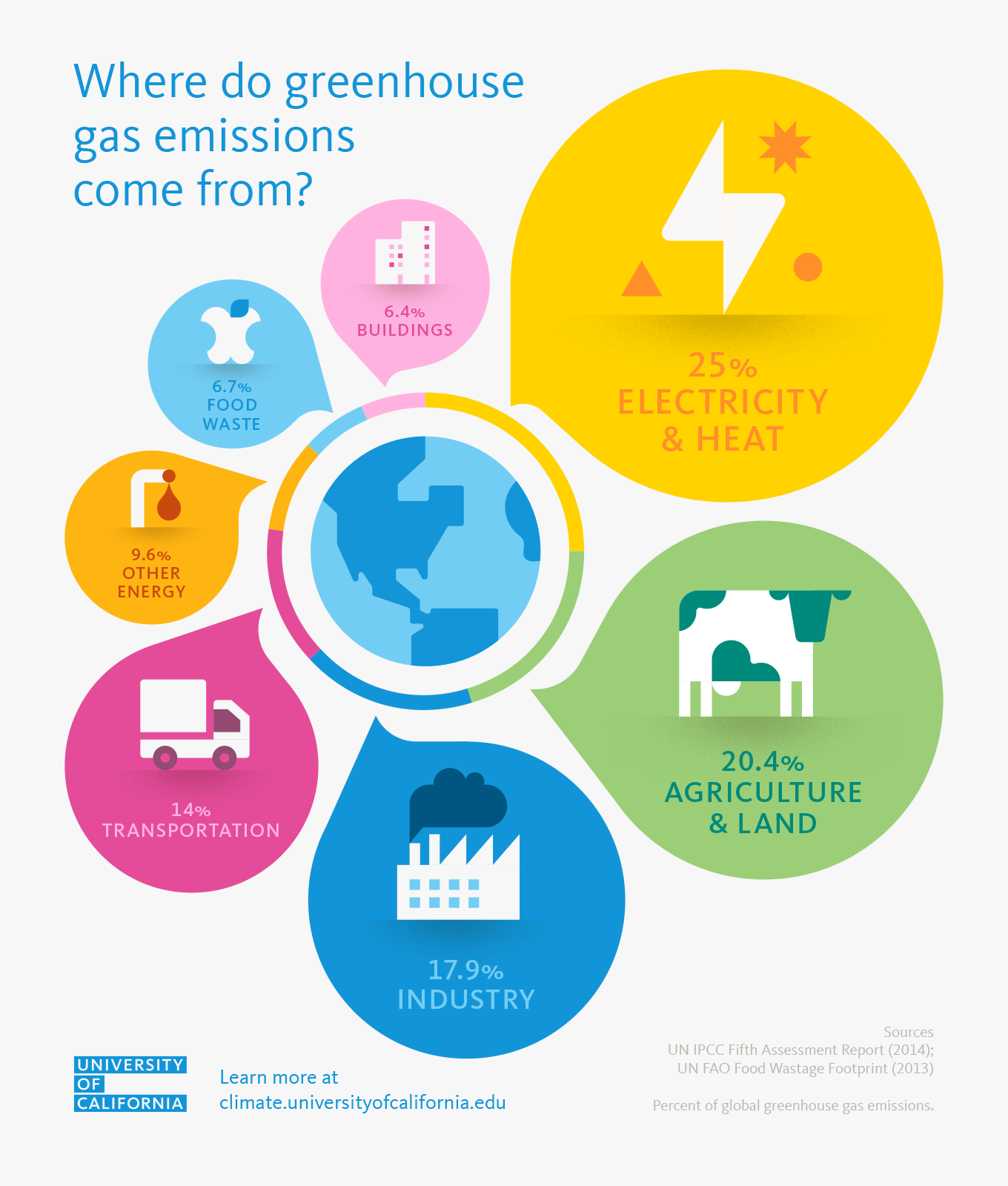
Growth in global greenhouse gas emissions in highest since In , the growth in total global greenhouse gas (GHG) emissions (excluding those from land-use change) resumed at a rate of %, reaching gigatonnes of CO 2 equivalent Oct 21, · Trinity College Dublin. (, October 21). Rice agriculture accelerates global warming: More greenhouse gas per grain of rice. ScienceDaily. Retrieved July 29, from blogger.com Apr 05, · On this basis, carbon dioxide emissions account for 80% of the contribution to global warming of current greenhouse gas emissions, as compared with

No comments:
Post a Comment